MentalHealth

  • Get your writing unstuck part 4: Fix the story

    Get your writing unstuck part 4: Fix the story

    A compassion-focused approach

    This final part of the series focuses on how to deal with a problematic writing project. When the reason you can’t write is because there’s something wrong with the story but you’re not sure how to fix it.

    Whether you’ve finished a draft, or are only partway through, sometimes the sheer complexity of the project can feel out of control. The story feels lifeless, or you’ve lost the spark that initially got you writing. Here are some methods to identify the problem and find the best way to fix it.

    Perfect is the enemy of good

    The first thing to recognise is that there is no such thing as a flawless book. Aiming for perfection is a recipe for frustration and disappointment. It’s also unnecessary. Think of your favourite books. Chances are you can list a number of problems and yet you enjoyed the story so much that those things just don’t matter.

    Perfection is unattainable but hooking a reader is a goal you can definitely achieve. Keep this in mind both while writing, and when you edit your story. What is the atmosphere you are trying to create? How can you engage your readers and make them care about the characters and what happens next in the story?

    Anoshi Saretzki, a writing coach on My Writing Matters, suggests that a writer should consider all the story elements and decide what roles they should play. Themes, sub-plots, points of view, conflict and tension, pacing, characterisation, worldbuilding, exposition and dialogue, language and style. “Go over these a few times to immerse yourself in the storyline and your approach – it often helps me identify the thing that’s keeping me stuck.”

    The reverse outline

    If you are more than halfway through your first draft, a reverse outline can be a useful way to find and fix problems. Especially if you are unsure how to get from where you are to the end of the story.

    The idea is to look at what you’ve already written and create a quick, rough outline. The process of doing this often helps to clarify where the problems are.

    Have two documents. One for the outline and one for noting the issues you discover. This is the “Idea Dump”.

    1. Make a list of every chapter in the story. Just one or two words that mark what happens.
    2. Under every chapter’s heading: make a list of every event in that chapter. Very short, just one or two sentences.

    Notice your reactions at each step:

    • Do you find yourself struggling to focus on a section? What seems boring?
    • Does anything make you feel defensive, because you know it needs to be changed but you’re resisting that reality?
    • What makes you feel that little spark of interest or surprise?
    • Are you finding plot holes or unresolved story threads?
    • Are there characters or events that feel redundant?
    • Are there any new ideas that present themselves?

    Record these reactions in the Idea Dump document. Keep it rough and casual. Don’t fuss about the order that things are jotted down, don’t worry about repetition. No one will see this except for you, so you don’t need to explain things you already understand.

    Once you’ve spent some time with the Idea Dump, have another look at the reverse outline. By now, you should have some ideas about what might need to change. Annotate that outline with notes for the changes you’re considering. If you’ve not completed the first draft yet, this is the point where you might feel ready to start outlining the part of the story you still have to write.

    Nerine Dorman, a writing coach on My Writing Matters, has this suggestion: “ Begin at the end of your story then work out which scene happens just before the ending and so on, until you reach the part where you got stuck.”

    Using “maybe”

    Sometimes the challenge is that there are just too many possibilities. Each choice sparks a new set of branching plotlines and this has you worried. What if this choice sends your story in the wrong direction? Here is a technique that might help:

    Making it clear that you’re trying out different options by writing that fact at the top of your list.

    • Write “Maybe this is what happens” or “Possibly” or some other word or phrase that gives you permission to experiment risk-free.
    • Note down a number of bullet points that briefly describe all the possible solutions you can think of.

    Don’t pre-edit this in your mind. No one else will ever see this; it doesn’t need to be perfect. Blurt it all out. Set out the worst and most ridiculous ideas, as well as the ones that seem plausible.

    As in the reverse outline, notice your own reaction to each point. Which options seem “correct but dutiful and a little boring” and which are “wild and I could never!”? Notice which get you hooked into wondering what might happen next. Those are the most likely to lead to reader engagement as well.

    Lean into the plot hole

    When dealing with inconsistencies and plot holes, always challenge your assumptions about what needs to be fixed. Sometimes the thing you’re trying your best to solve, polish  or remove is the exact thing that ups the stakes and ads an original twist to the story.
    For example, your character is in a situation where they might get captured. You’ve set the stakes so high that it’s difficult to figure out how they’re going to avoid capture.
    Instead of constructing a difficult-to-believe series of coincidences to smooth over this issue, why not let it go wrong? Allowing the reader to see the bad thing actually happen and then being resolved, or the consequences for that failure playing out, is much more interesting than keeping things neat and safe.

    Fix it in the next one

    Assuming that you are going to share your writing, whether by publishing it or sharing it on social media, the time will come when it’s time to let it go out into the world. You’ve done everything you can to make it the best story it can be but you still see its flaws.

    It can be tempting to do just one more re-write, to polish it just a little more. Or you might not feel confident enough to take that next step. What if it’s really not good enough?

    This is especially true if you’ve already employed a writing coach or editor to help you bring this project to the finish line. There comes a time when you can acknowledge the problems in the project and still let it go. Fix it in the next one! Write another story.

    More reading on this topic:

  • Get your writing unstuck part 3: Get motivated

    Get your writing unstuck part 3: Get motivated

    A compassion-focused approach

    The first article in this series covered the three self-regulation systems. The second looked at the specifics of using the drive and soothe systems to regulate your energy and anxiety levels so that you can get writing again.

    This article is about motivation strategies, and ways to build a writing routine, set writing goals and maintain momentum.

    Self-acceptance

    There’s an overwhelming amount of writing advice in the world. Articles, self-help books, Reddit posts and YouTube videos. That’s in addition to all the advice from your parents, teachers, colleagues and friends. When those so-called “common sense” techniques don’t work it’s easy to assume that you are the problem. That you’re broken, lazy or lacking in talent. That you’re not a “real” writer.

    The fact is that people have different needs. A technique that works for one writer can fail miserably for another. If a piece of writing advice makes you feel like you should give up, that’s a sign that it’s bad advice for you.

    If you’ve been using the threat system to motivate yourself it can be difficult to change. There’s a voice in your head telling you that those harsh words are keeping you safe, that you’ll never get anything done if you stop scolding yourself.

    The opposite is true. Self-acceptance, patience and compassion are essential for creating a long-term, sustainable writing routine. There will be times when you’ll have to push yourself to do something that doesn’t come easy. But the better you get at regulating your emotions and energy levels as mentioned in part 2 of this series, the more skilled you’ll become at tolerating discomfort.

    Instead of the vicious cycle of self-blame sapping your resolve, you can create a virtuous cycle. Gradually building up reserves of emotional energy so you have the strength to boost yourself over the difficult parts.

    Building a writing routine

    The most common advice on how to build a writing routine is “write every day”. This might work for some but it’s hardly ever as simple as just deciding to write every day. Apart from the fact that many people simply can’t set aside time for writing that often, it’s far too vague to be a useful goal. What does it mean, exactly? How much writing should get done? Does spending half an hour staring blankly at your laptop count as writing? What about thinking about plot holes while you’re washing the dishes? You might not consider the second example to be “real writing” but it’s much more likely to be useful!
    Deciding on an ambitious goal might feel good in the moment but it’s setting yourself up for failure.

    How to set a writing goal

    To create a useful writing goal:

    • Keep it small
    • Be precise

    Set a minimum limit and allow yourself to exceed it. “Half an hour a week” or “I will just open the document and look at it”. Broaden your idea of what counts as writing. Going for a walk while you puzzle over a plot hole can be very useful! Find the easiest route into the project. Refer to part 2 of this series for productive procrastination techniques.

    How to meet your writing goal

    • Reduce friction and distraction
    • Create a consistent ritual
    • Note your progress
    • Use accountability

    Reduce friction and distraction: Very often the most difficult part is just getting started. To deal with this, take some time to look at your writing setup and find the things that get in the way.
    Is your writing desk piled high with unfolded laundry? Do you end up not writing because your laptop’s battery is drained and you can’t find the power cord? Prepare your writing space and equipment so that all you need to do is sit down and start. Every time you fail, notice what stopped you. What got in the way? Can you stop that from happening again?
    Invest in noise-cancelling headphones.
    Have that conversation with your spouse about doing the laundry to free up your time.

    Create a consistent ritual: Design a writing routine that’s possible for the situation you are in right now, with the brain, mental energy and financial resources you actually have. You might dream about a lengthy idyll in a cottage by the sea but you might in fact do better at the local coffee shop, half an hour, once a week.

    Note your progress: It can be easy to fall into the trap of always driving yourself and never looking back to see how far you’ve come. Even when the “ten minutes a week” has turned into several hours of writing a day, you still feel guilty about every moment you spend relaxing away from the keyboard.
    Keep track of your progress and notice how far you’ve come. Be realistic about your capacity. Very likely you’ll find that you have short bursts of high productivity, followed by slower times. This is a normal part of the writing process, where problem-solving and creativity are often invisible or impossible to track.

    Use accountability: Writing can be a solitary process. It can be difficult to stay motivated, especially if you’re setting your own deadlines. Consider finding an accountability partner. This could be a friend, or another writer. Sometimes simply stating what you plan to achieve can help you stay focused.

    Some tips on momentum

    Since starting can be particularly difficult, find ways to ease that process.

    Stop while you’re ahead. Instead of writing till you run out of steam, stop writing while you still know what’s going to happen next, or when you feel excited to start the next scene.

    Keep a separate “questions” document to jot down notes of issues that might otherwise derail you. Instead of stopping in despair every time you realise there’s a plot hole- or get distracted into research every time you run into a gap in your knowledge, make a note of what you’ve noticed and keep writing. This also makes it easier to deal with those “I simply can’t write” days. Looking at that list of specific questions and issues can be easier to deal with than diving into the project itself.

    Be careful who you share your writing with, especially early in the process. An experienced writing coach or editor can be invaluable. Conversely, a well-meaning friend might say the wrong thing, unintentionally draining your good vibe.

    Save your juice for your writing. It might be tempting to tell everyone about your writing project. But talking about it too much risks diverting creative energy that should go into your writing. Sometimes talking about an unfinished project gives your brain the illusion of creative satisfaction, that spark of joy in completion… when you’ve not actually written anything! Wait till the first draft is finished before sharing your excitement.

    Build trust in your own capacity

    Even with the most sustainable goal and the perfect writing setup, there will be parts of your writing process that feel uncomfortable, boring- or overwhelming. You might have been taught it’s all about willpower. You might even believe that you lack the innate quality, that drive to push through.

    In reality, this is a skill like any other. It can be learnt and gets easier with repetition and familiarity. Your capacity to tolerate those unpleasant feelings will grow over time as you show yourself that you can succeed even if it doesn’t always feel easy.

    This can be especially difficult if you are used to others ignoring your boundaries and disbelieving your needs. “I just can’t do that!” can be a useful statement when dealing with insensitive or ignorant people. But when the boundary you set for others becomes internalised, you might start thinking of yourself as incapable or helpless.

    To counter this, take note of your self-talk. How often do you tell yourself “I just can’t do this”? What happens if you change that into “Let’s see what happens if I try”? When you fail, instead of “See? I can’t”, rather list the things you could change to make it better next time. When you succeed, instead of lashing out at yourself with a “That wasn’t so difficult; why do I always make such a fuss”, try “I set myself a goal and I succeeded. That’s a good thing”.

    We’re often told to use positive self-affirmations but these can feel false and dishonest. Instead, try realistic self-compassion. Change “I’m never going to be able to handle the shame if I don’t finish this project” to “I’m going to give this my best shot. If it doesn’t work out, I’ll figure out a different way”.

    Use a writing coach

    An experienced writing coach, like those listed on this site can be especially helpful in guiding you through this process. Someone who can suggest methods suited to your exact situation, and who can act as a neutral accountability partner to help keep you on track.

    A note on self-talk

    It can be difficult to change the habit of a lifetime of negative self-talk. Especially if you are autistic or ADHD! Fearful or angry rumination is a common challenge for neurodivergent people.
    Even if you’re not neurologically predisposed to rumination and negative self-talk it’s often not something you can just decide to stop doing. And it certainly won’t help to scold yourself for scolding yourself!

    Whenever rumination occurs:

    1. Note that it’s happening
    2. Give it a non-judgemental label, describing what’s happening (“I’m having an argument with an imaginary person” or “I just called myself an idiot”)
    3. Check your needs – are you hungry or tired? Address those needs

    See rumination and negative self-talk as a neutral sign that you’re dysregulated. Instead of believing that inner voice really is something worth listening to, think of it as an emotional smoke alarm. An inexact signal that there’s a physical or emotional need that requires your attention.

    The next article in this series looks at the final reason you might be stuck in your writing process and how to fix problems with the story that might be stopping you from moving on.

    Part 4 of this series: Fix the story

    More on this topic:

  • Get your writing unstuck part 2: Get in the writing zone

    Get your writing unstuck part 2: Get in the writing zone

    A compassion-focused approach

    If you’ve been struggling with motivation, or can’t maintain momentum on a writing project, you’ve probably encountered a lot of advice and tried many techniques. You might be feeling despondent, desperate to find something that works. To avoid repeating what you’ve already tried, it’s important to identify the underlying cause. Then you can choose the techniques that will work for you in your individual situation.

    The previous article covered the basics of self-regulation, referring to the threat, drive and soothe systems. This article will look at when and how to apply these systems in the context of writing.

    In most cases, there are three reasons why people feel stuck with a writing project. You might be struggling with all three!

    1. Practical difficulties such as limited time and energy, the demands of family or work and challenges with physical or mental health
    2. Using the wrong motivation strategy for your specific type of brain
    3. Something is wrong with the project and you can’t move on until you’ve fixed it

    Dealing with practical difficulties: the window of tolerance

    If the reason you can’t write is because you are exhausted or struggling with physical or mental health, it helps to be aware of your window of tolerance.

    The window of tolerance is the ideal state for your nervous system to be in, neither under- nor overstimulated. This is the level at which you can learn new skills and do creative work.

    Picture your emotional states arranged vertically, with the highly stimulated states like fear, anger, anxiety and stress near the top and the low-stimulated states like boredom and depression near the bottom. The mental states that are useful for doing creative work are near the middle. Energised enough to be able to work and focus but not so much that you are overwhelmed. This is the window of tolerance.

    A infographic showing three zones stacked vertically.  The top is labelled "over" and contains the words "terrified, scared, anxious, angry, stressed". The middle is labelled "window of tolerance" and contains the words "energised, focused, relaxed". The lower is labelled "under" and contains the words "bored, unfocused, tired, exhausted, depressed"

    When you are tired or ill, your window of tolerance is narrower. Things that you’d normally take in your stride are suddenly unbearably irritating or frustrating. It takes more energy and effort to lift yourself out of the cloud of exhaustion or fatigue.

    When you are writing, you’re being creative, generating ideas and solving problems. That’s inherently stimulating, which can be a problem if you are already anxious or irritable: near the top of your window of tolerance. And if you are too low, it can feel impossible to generate the necessary energy to do anything at all.

    The previous article dealt with the three systems involved in self-regulation. Understanding those can be useful when trying to manage these levels. Drive system activities can help to lift your energy to where you feel able to engage and the soothe system can lower your stress levels to move you out of the red zone.

    In most cases, the threat system is not appropriate and should be avoided. Learn to be patient with yourself. Scolding and threats might be a difficult habit to break but self-compassion is far more effective.

    When life gets too much

    It’s possible that the practical problems that are keeping you from writing need solutions outside the scope of this article. Make an appointment with a doctor or a therapist, organise someone else to take on household chores and childcare, find a distraction-free writing space, set boundaries with family members. All easy to describe but challenging to do!

    You might have to put the writing project on hold until things have improved. Pencil a date on the calendar a month or three, or six, -from now. Allow yourself a guilt-free break from the constant “but I should be writing”. Until that date comes, don’t even think about writing. You’re not giving up,  you’re giving yourself a chance to recover and regroup. When your break is over you can re-assess your capacity.

    Upregulating

    If you’re struggling to focus and find yourself easily distracted, it might be your nervous system telling you it needs more input. You’re bored! For many people this is a danger zone. This is -where temptation lurks. The easiest thing is to grab your phone and find some dopamine-inducing outrage bait on social media. An argument with an online stranger, or an evening spent doomscrolling might feel engaging in the moment but it’s ultimately draining and it’s definitely not going to help you get any writing done! Making a list of alternative activities can help avoid this particular trap.

    Downregulating

    Another type of distraction happens when you’re too high on that emotional scale. You can’t stop anxiously ruminating and just the idea of writing feels overwhelming. Giving yourself permission to do some gentler tasks, or to have a self-care break, can make a big difference to your capacity.

    Writing-related tasks to regulate your energy

    The following activities can be used to activate your drive system, to satisfy your craving for novelty and reward, or the soothe-system, to help you heal and recover. Reading through these, you might think, “But this is just procrastination!”

    It might be useful to think of this as productive procrastination, a way to ease yourself into the right gear for the more difficult work. Your writing mind is like a shy, wild, independent creature. A cat- or a wolf, or a tiny bird, whatever suits your vision of yourself. Trying to trap it or scold it won’t work. But you might be able to entice it into action by creating an environment that makes it feel safe and respected.

    Be honest with yourself. Any of these might become a way to avoid writing, rather than a path back to storytelling. Check in often to see if you are meeting your goals (the next article in this series looks more closely at how to set writing goals.)

    Music! Create a playlist to put you in the zone. Whether you prefer ambient music, game soundtracks, techno, heavy metal, or whatever genre you please. Dedicating a playlist for writing time only can help put you in the zone.

    Soundscapes. If music is too distracting, consider exploring tabletop role-playing sites to download ambient sounds that evoke the atmosphere you’re writing about. Listening to natural sounds of rain, distant thunder or the ocean can reduce anxiety and help you focus. Explore Tabletop Audio for many free downloads or use a browser-based soundscape like MyNoise.

    Engaging your writer brain. Whether you’re reading a book or watching a movie or a show, notice how you respond to the story. What affects you? Why are you bored? How did a character engage your sympathy? Do you care what happens next – why, or why not? And once in a while, check in on your own project. How can you use what you’re learning in your own story?

    Work visually. Draw your characters or make a mood board. Search the internet for images that evoke the vibe you’re trying to create. Whether its costumes, landscapes- or people, finding fresh approaches can be inspiring.

    Work spatially. Break out of the linear straitjacket of text by using index cards or drawing branching timelines. Use tools like Scapple or Obsidian.

    Explain your story to an imaginary, infinitely patient and interested person. Often talking out loud can help you find your way back to what initially excited you about the story.

    Move, or change your environment. Choose an aspect of your project that needs some thought. Then, holding it lightly in mind, go for a walk or have a shower. Often this helps find new approaches and solutions.

    Writing snacks. Have a stash of especially tasty treats reserved for when you’re writing.

    Create a writing ritual. Use a combination of the above to build a ritual that will get you in the writing mind space. Set up your laptop or notebook, silence notifications, prepare the snacks or drinks, cue the writing playlist on your noise-cancelling headphones.

    Other regulation methods

    Some more techniques to change your energy and deal with anxiety or inertia. All of these should be done with a gentle, non-judgemental approach. Watch out for that internal “why can’t I just—” or “I should be able to—” scold. Keep your goals small and achievable and notice your successes.

    • Movement. Even small movements can bring you out of your head and into your body, making it easier to overcome the inertia that’s keeping you locked to your phone or slouched on the sofa. Stretch. Shake out your shoulders. Try getting up.
    • Music and dance. This is different from the writing playlist mentioned above. This is music that gets you dancing, your favourite “on repeat” tunes.
    • Go outside and look at something in the distance. Many people find that looking at the horizon- or the clouds reduces anxiety and helps to calm their nervous system.
    • Do something repetitive like knitting, doodling or building a puzzle.
    • Splash cold water on your face or place an icepack on the back of your neck.
    • Do a deep-breathing exercise like box breathing.
    • Do aprogressive muscle relaxation exercise.
    • Use a weighted blanket or compression vest.
    • Play with a fidget toy.

    Make a menu

    It can be useful to make a list of these activities. A menu of suggestions that’s easily available when you’re feeling too brain-fogged to resist the siren song of your phone. Put it on the home screen of your phone or stick it to your fridge. Wherever you’re likely to see it!

    The next article in this series is about regaining momentum, motivation and how to set writing goals.

    Part 3 of this series: Get motivated

    More reading on this topic:

  • Get your writing unstuck part 1: Self-regulation for writers

    Get your writing unstuck part 1: Self-regulation for writers

    A compassion-focused approach

    This is the first in a series of articles to help you start writing again. They suggest new ways to think about your process, as well as practical tips and techniques, whether you’re completely blocked, or able to write but frustrated with your lack of progress. The goal is to rediscover what started you writing in the first place and make writing an interesting and fulfilling challenge, rather than a chore.

    The techniques that follow are based on compassion-focused therapy (CFT), an evidence-based therapy modality. A CFT approach can benefit anyone but it’s particularly suited to the needs of neurodivergent people, especially those who struggle with executive function, emotional regulation and self-doubt. This article is a brief overview of some CFT concepts that will be referred to in the rest of the series.

    CFT and self-regulation

    Compassion-focused therapy frames being stuck with your writing as a challenge of self-regulation, that is, the ability to manage your emotions- to get yourself to do something, or to stop doing something. The advantage of CFT is that its methods are sustainable and effective and won’t cause burnout and exhaustion.

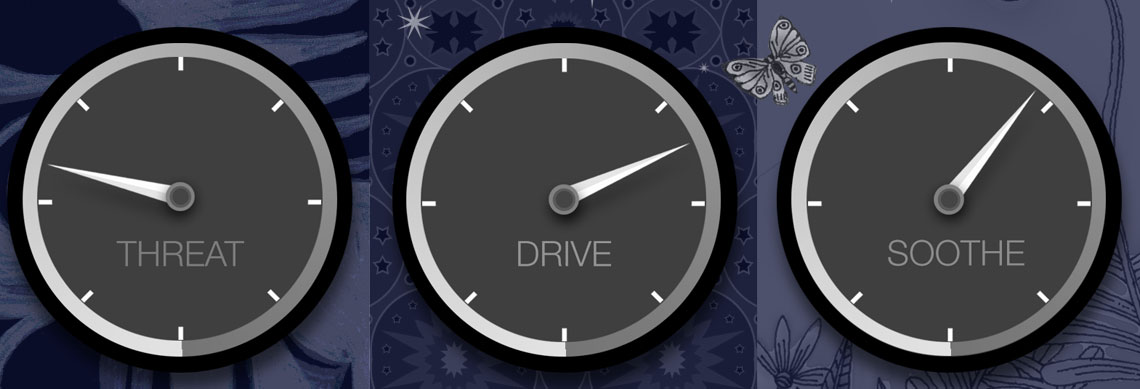
    According to the CFT approach, we, as humans, use three systems to self-regulate. The threat system, the drive system and the soothe system. Each has its place in your life. Knowing how to choose the correct system for a particular situation can mean the difference between success or frustration.

    A mechanical drive labeled "THREAT" with the needle pointing up and to the left. The rim of the dial is bright red

    Threat system

    The threat system is all about avoiding danger. This is the mode that most of us are familiar with. Scaring yourself into action by evoking all the bad things that might happen if you don’t do the work. Using anxiety as a goad to drive yourself into action.

    Often, our parents and teachers have relied on the threat system and for many of us, it’s the only motivation technique we’ve ever been taught. You might be familiar with these thought patterns:

    “If I don’t study for this test, I will fail the whole year and I’d feel so much shame. Everyone will be disappointed in me”

    “I have to learn to drive otherwise I’ll never get a job and will end up homeless and lonely.”

    The threat system is very good at conjuring up the terrible consequences that might happen if you don’t do whatever it is you’re trying to force or scare yourself into. In an upside-down way, it can make you feel safe. You’re preparing for the worst, after all. If you’re always ready for the worst-case scenario, you’ll be ready for whatever might happen.

    Or that’s what you tell yourself.

    The reality is that this is not sustainable. The threat system puts your body in emergency mode, activates the sympathetic nervous system that puts us in “fight, flight or freeze” mode.
    This happens because your nervous system doesn’t differentiate between imagined dangers and physical threats. Your body responds to imagined risk as if you are in actual physical danger.

    When you’re stressed, the stress hormones adrenaline and cortisol are released into your bloodstream. Your heart rate increases and your muscles are readied. Your nervous system is prepared for hyper focus and action. Resources are diverted away from digestion and sleep. Writers often have particularly active and vivid imaginations. We’re good at conjuring up terrible scenarios. You tell yourself: “-If I don’t do this work, I’m going to lose my job and then I won’t be able to pay my rent…” and the next minute your heart is racing and you’re wondering if you have enough suitcases for all your stuff.

    This can be effective, even lifesaving in moments of actual danger. But it’s not a state you can stay in long-term. When sustained, this leads to burnout. It harms both mental and physical health.

    A mechanical dial labeled "DRIVE" with a needle pointing up and to the right. The rim is golden yellow

    Drive system

    Where the threat system is to get away from danger, the drive system is all about moving towards a reward. The activities that activate your drive system are fun, exciting and engaging.

    The drive system is more individual than the threat system. Most people, broadly speaking, fear the same things. Some of us might be concerned about bad things happening to our loved ones and some might be worried about avoiding unemployment but whether it’s loneliness, pain, illness or death, our fears are fairly universally shared.

    By contrast, – drive system activities tend to be different for each person. Some people thrive in competitive team sports; others enjoy the challenge of playing a musical instrument. Some people love arguing with strangers on social media; others long to play their favourite puzzle game all by themselves.

    The drive system is often quite competitive. It fulfils the need for internal or external validation. You might be motivated by the chance to show off your skill for others to admire, or you might be drawn to that feeling of internal satisfaction as you complete a difficult task. When employed correctly, the drive system can engage a satisfying flow state of creating and learning.

    The neurochemical associated with this system is dopamine. Dopamine is often misunderstood to be a feel-good, “pleasure” chemical but it’s actually part of the brain’s motivation system. This is too complex a topic for this article but a simplified explanation is that dopamine is your brain’s way to send a signal that you’ve succeeded at something: “You’ve done a thing. Do more of that.”

    Activities that engage the drive system typically require energy and might be tiring. But unlike the threat system, if managed properly, they make you feel enriched instead of exhausted.

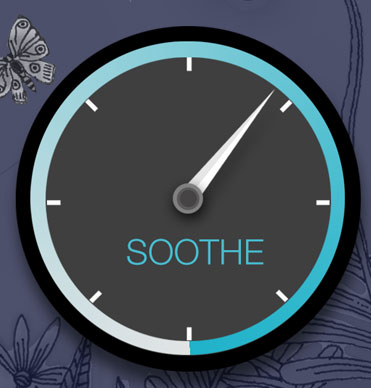
    A mechanical dial with the label "SOOTHE" and a needle pointing up and to the right. The rim of the dial is pale blue

    Soothe system

    The final self-regulation is the soothe system. Activities that activate this system help you to relax and de-stress. Like the drive system, this is quite individual. Hugging a pet, taking a walk in a forest, snuggling in a duvet with a favourite book, listening to music or meditating –everyone has their own preference.

    The soothe system activates the para-sympathetic nervous system. It allows your body to downshift from the stressful “fight, flight -or freeze” response, so that you can sleep and recover. Where the threat system is often triggered by thoughts, soothe system activities typically bring you back into your body – grounding exercises; deep, slow breathing; being immersed in a favourite comfort read; enjoying a favourite drink or snack; or hugging a loved one.

    Which system is best for writing?

    Each of these three systems, threat, drive and soothe, has its place. It’s not that one is better than the others. When an urgent deadline looms, it might be necessary to remind yourself of the consequences of missing it, so the threat system can be very useful. Drive system activities can be energising but also addictive and exhausting. For example, distracting yourself by scrolling social media. And soothing activities are essential but you would stagnate if you stayed permanently in that state alone.

    The next article will cover using this knowledge to support your writing process. How to identify what’s causing your difficulties and which activities you can use to engage the appropriate system.

    Part 2 of this series: Get in the writing zone

    More reading on this topic: